👋 Welcome to the March Edition
This month marked a milestone, 8 years of QuillAudits. 1,500+ protocols audited, $3B+ in user funds protected, and 1M+ lines of code reviewed across 3 bear markets and every phase of Web3's evolution. That experience now powers our Multi-Layer Audit system and QuillShield, our AI-powered Red Team Copilot, bringing audit intelligence directly into developer workflows.
On the research side, we published a comprehensive Q1 2026 exploit report covering $160M+ in losses across 18 exploits, expanded into Hyperliquid threat modeling, end-to-end RWA security frameworks, and autonomous AI agent risks in DeFi, while breaking down every major March exploit from Resolv's $25M backend compromise to Venus's donation attack and Solv's double-mint bug.
Beyond research, we hosted live sessions on external audits vs internal security teams and AI's real impact on smart contract auditing, and we're heading to Dubai during TOKEN2049 week for curated security roundtables and an RWA-focused mixer.
Here's a concise roundup of our research, exploit investigations, community conversations, and upcoming engagements from the past month.
From the Quill Research Desk
Our March research spanned RWA security frameworks, Hyperliquid application-layer threat modeling, AI-agent risk surfaces, and our most data-driven quarterly exploit report to date.
Q1 2026 DeFi Exploit Report - $160M+ Lost Across 18 Exploits
We published a full-quarter damage report mapping every major DeFi exploit from January through March. Smart contract bugs led by frequency (6 exploits, $38.6M), while compromised private keys hit hardest per incident ($36.9M from just 2 hacks). The report highlights the widening gap between audit coverage and post-deployment monitoring, reinforcing the case for continuous on-chain surveillance.
RWA Security Risks & Best Practices: Securing Tokenized Assets End-to-End
With tokenized asset value surpassing $26B across 33 networks, RWA security can no longer rely on smart contract audits alone. We published a structured analysis of the five-layer RWA security stack, covering physical asset risks, legal dependencies, operational vulnerabilities, oracle exposures, and on-chain logic, arguing that RWA protocols require auditors who understand blockchain security, traditional finance, and regulatory compliance together.
Hyperliquid Security: Beyond Orderbooks and Into Architecture
Hyperliquid's dual-engine architecture introduces a fundamentally different threat model from Ethereum-native DeFi. We dissected security implications of its deterministic finality, validator trust assumptions, and on-chain orderbook design, providing an actionable audit framework for teams deploying on HyperEVM.
Autonomous AI in DeFi: The Security Framework We Need
AI agent wallets that autonomously manage assets and execute trades are entering DeFi at scale. We analyzed emerging risks, including prompt injection, data poisoning, supply chain compromise, and non-deterministic execution in irreversible on-chain environments, outlining a practical mitigation framework for building resilient autonomous systems.
March's research reflects a consistent trajectory: as infrastructure scales beyond smart contracts into off-chain coordination, AI-driven execution, and real-world asset claims, security models must expand to match the full attack surface.
Hack Watch
March saw $33.5M drained across five exploits, closing out a quarter that totaled over $160M in losses. The month's incidents ranged from compromised backend infrastructure to known vulnerability classes in forked lending protocols and callback-driven double-mint bugs.
Resolv Labs $25M Exploit Explained
Resolv Labs suffered Q1's single largest exploit. The attacker compromised the protocol's AWS key management service, gaining control of a backend SERVICE_ROLE that passed mint amounts as unchecked parameters with no on-chain validation. Three transactions, $300K deposited, 80M unbacked USR minted. The peg collapsed to $0.025 within 17 minutes. The attacker still extracted $25M, an 83x return.
Venus Protocol $5M Exploit Explained
Venus lost $5M through a donation attack on BNB Chain, a known Compound V2 design flaw. The attacker spent nine months building an 84% of cap $THE position, then bypassed the supply cap entirely via direct ERC-20 transfers to the vTHE contract, inflating the exchange rate by 3.81x without minting a single new vToken. A self-reinforcing borrow-swap-donate loop across ~50 transactions extracted 20 BTCB, 1.5M CAKE, and 2,172 WBNB. This vulnerability class was flagged in Venus's own audit.
Solv Protocol $2.5M Exploit Explained
Solv lost $2.5M to a double-mint bug in its BitcoinReserveOffering contract. The onERC721Received callback minted BRO tokens during an NFT transfer, then mint() minted again when execution returned. The attacker looped this 22 times in a single transaction, turning 135 BRO into 567M, converting 165M into 1,211 ETH before routing proceeds through RailGun.
Aave V3 also took a $1M hit from an oracle issue, a reminder that even the most established names aren't immune.
The quarter's pattern is clear: audited protocols are still shipping bugs, and the most damaging attacks increasingly target infrastructure outside the smart contract itself. That's the gap between audited and monitored, and it's where the real damage is happening. That's exactly what QuillAudits On-Chain Monitoring Service fills, real-time threat detection, oracle surveillance, and automated response that catches what audits can't.
Track all Q1 2026 exploits and live attack data on QuillMonitor.
QuillAudits Stats
A quick look at our March audit activity and how we helped secure the Web3 ecosystem.
Where to Find Us Next
We're continuing our closed-door security roundtables and curated gatherings across major global hubs, bringing together institutional builders, senior engineers, auditors, and protocol architects shaping digital asset infrastructure at scale.
Security Roundtable - TOKEN2049 Dubai (April 29)
A private, invite-only roundtable for senior technical leaders building and securing blockchain infrastructure. The session covers real-world protocol failures, recent exploit deep dives, and defensive security design drawn from QuillAudits ongoing audit and investigation work across DeFi, infrastructure, and application-layer protocols. Structured for peer-level, off-the-record dialogue among CTOs, security researchers, protocol architects, and heads of engineering.
RWA Security Mixer - TOKEN2049 Dubai (April 30)
Built on insights from our RWA Development & Security Report, this curated mixer brings together founders, investors, protocol teams, and infrastructure providers operating at the intersection of RWAs, tokenisation, and institutional DeFi. Discussions focus on smart contract architecture, audit readiness, compliance alignment, oracle dependencies, custody risk, and operational resilience. A focused, invite-only setting designed for strategic introductions and long-term collaboration.
If you're building, auditing, or investing in digital asset infrastructure and will be in Dubai during TOKEN2049 week, let's connect.
Community Highlights
March brought a major partnership announcement, a keynote at one of Ethereum's flagship security events, and two live sessions cutting through the noise on audit models and AI in security.
Cointelegraph Connect Cannes - Security Partner & $40K Audit Grants
We joined @Cointelegraph as a security partner for their Cointelegraph Connect Cannes event. To support the Pitch Competition, we've allocated $40,000 in audit grants for teams preparing to take their products to market, helping builders move from idea to secure deployment with confidence.
EthCC x RektHQ Security Summit
@ParthoRoyC spoke at the EthCC x RektHQ Security Summit on "Beyond the PDF: Scaling Security Through Collective Trust", a conversation around how security is evolving beyond one-off audit reports toward continuous, multi-layered defense systems where auditors, researchers, and bounty hunters operate as an ongoing layer of protection. The model is changing, and it's good to see the conversation catching up.
Internal Security Teams vs External Auditors - Who Actually Secures DeFi?
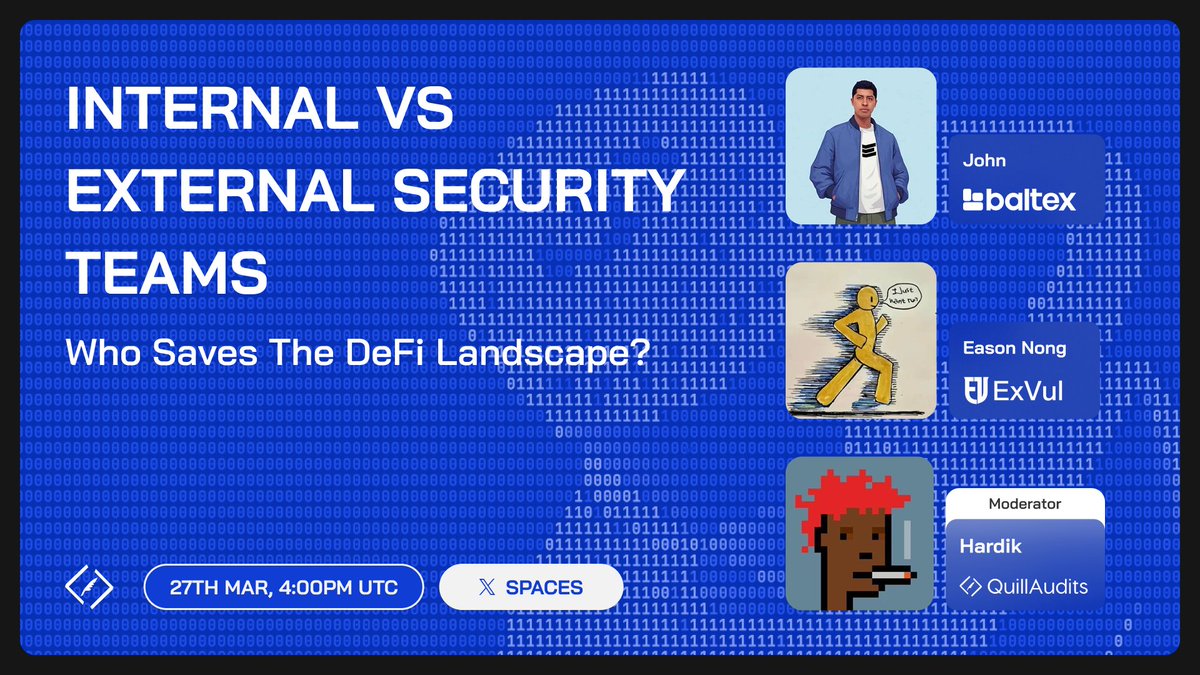
We hosted a live session with John Ospina (Head of Business, Baltex) and Eason Nong (Security Researcher, ExVul), examining whether the audited badge has become a misleading trust signal, whether any single firm can cover multi-chain nuances across EVM, Solana, Sui, and Aptos, and where a protocol's first security dollar should actually go.
➡️ Listen to the full conversation: Here
AI vs Hackers: The Future of Smart Contract Auditing
Joined by @Sasho (CTO, Hackenproof), @Tim (Founder, Peeramid Labs), @Tomer (CTO, Auditware), and Siddharth (Founder, Kairo), we discussed why AI still isn't dominating bug bounties, the accountability gap when AI-audited protocols get drained, and the closed-loop problem of AI reviewing AI-generated code.
➡️ Listen to the full conversation: Here
Across all of it, one theme stood out: security is moving from static, point-in-time deliverables toward continuous, collective defense, and the builders, partnerships, and conversations shaping that shift are accelerating.
Wanna partner up w/ us or want to get your project audited? |
|
|
Have a great day,
Team QuillAudits